
What the Insurance Company Quietly Removed From the Number Before They Called You

The call comes faster than most people expect. You’re still icing your shoulder, still waiting on the MRI results, still figuring out whether you can go back to work next week — and the adjuster is already on the phone with a number. It sounds reasonable. It might even sound generous. And that’s exactly the problem.

I’ve been doing this long enough to recognize the pattern. The offer arrives before the full picture does. Before your doctor has weighed in on whether that disc injury needs surgery. Before anyone has added up the shifts you’ve missed. Before you’ve had a single honest conversation about what the next six months actually look like. The insurance company knows what it’s doing. The question is whether you do too.

The Moment Before You Sign Is the Only Moment That Matters

Here’s what I see regularly in my practice: someone accepts a settlement, signs the release, and then — two months later — gets a diagnosis that changes everything.

A herniated disc that didn’t show clearly on the first scan. A knee that needs surgery the orthopedist initially thought would heal on its own. By then, it’s too late. The release they signed didn’t just close the claim. It closed the door on every future cost connected to that injury.

That’s not a technicality. That’s the entire game.

When you sign a personal injury release in Illinois, you are typically waiving your right to any further compensation from that incident — forever. The insurance company knows this. Their adjusters are trained to move quickly, before your treatment stabilizes and before you understand what you’re actually giving up. A personal injury attorney ma will tell you the same thing from a different coast: the pressure to settle early is universal, and it almost always benefits the insurer, not the injured person.

The first offer is rarely the full picture. It’s a starting position.

What a Complete Claim Actually Includes

Most people have gaps in their understanding of what compensation is supposed to cover. That’s not an accident — it’s where insurance companies quietly do their best work.

Medical Expenses: Past and Future

Medical bills are the most visible category, but also the most commonly undercounted. The adjuster might acknowledge your emergency room visit and your first few follow-up appointments. What they often don’t volunteer: future medical expenses.

If your injury requires physical therapy for six months, a surgical consult, or ongoing pain management, those costs belong in your claim. Personal injury claims can include money for medical bills, lost wages, emotional harm, and other losses — and that coverage extends to future treatment, not just what’s already been billed. Expert testimony from a treating physician about your projected care needs can significantly increase what a claim is worth, particularly in back and spine injuries where the full extent of damage takes time to emerge.

Lost Wages vs. Lost Earning Capacity

These are not the same thing, and the distinction matters enormously.

CategoryWhat It CoversDocumentation Needed
Lost wagesDays and shifts already missedPay stubs, employer letter
Lost earning capacityReduced ability to work going forwardMedical opinion, tax records, vocational expert
Self-employment lossesIncome disruption for business ownersTax returns, client contracts, financial records

Most early offers account for the first column. The second and third are where significant value gets left behind. If you’re a tradesperson who can no longer lift, or a driver who can’t sit for long periods, that’s lost earning capacity — a separate and legitimate component of your claim that the adjuster’s opening number almost certainly didn’t include.

Pain and Suffering

There’s no receipt for it. But it’s real, it’s compensable, and it’s often the largest component of a serious injury claim.

Illinois doesn’t cap pain and suffering damages in most personal injury cases. The calculation typically involves either a multiplier applied to your economic damages or a per diem approach that assigns a daily value to your suffering over the recovery period. What matters here is documentation: consistent medical records, notes about how the injury affects your daily life, and a clear narrative that connects the accident to your ongoing limitations.

Adjusters will minimize this category if you let them. Don’t let them.

The Categories Nobody Mentions

  • Property damage
  • Out-of-pocket transportation costs to medical appointments
  • Loss of consortium, if the injury has affected your family relationships
  • Home care or assistance costs during recovery

None of these are automatic. You have to know to ask for them.

How the Insurance Company Builds Their Number

Understanding how adjusters actually calculate an offer changes how you respond to one.

Insurance companies use claims software — systems like Colossus are well-documented in the industry — that weighs injury type, treatment duration, and medical costs against a database of similar claims. The output is a range. Adjusters are typically authorized to offer somewhere within that range. The bottom of the range is where they start.

What the software doesn’t capture well: the specifics of your life.

It doesn’t know that you coach your kid’s soccer team and haven’t been able to for four months. It doesn’t know that your job requires physical tasks you can no longer perform. It doesn’t know that you’re still waking up at 3 a.m. because the pain won’t let you sleep. Those details matter in negotiation, and they matter even more if a case goes to a jury.

A lowball offer is often a signal, not a final answer. It frequently means the adjuster has assessed the claim as one where the injured person doesn’t have representation and may not push back. Many straightforward claims settle at figures far below what a fully documented claim would support — not because that’s what the case was worth, but because the injured person accepted the first offer without understanding what was missing.

The one question I’d want answered before anything else: Does the offer account for your future medical needs? If you haven’t reached maximum medical improvement — the point where your doctor says your condition has stabilized — you shouldn’t be settling. Full stop.

Illinois Fault Rules and Why They Matter to Your Number
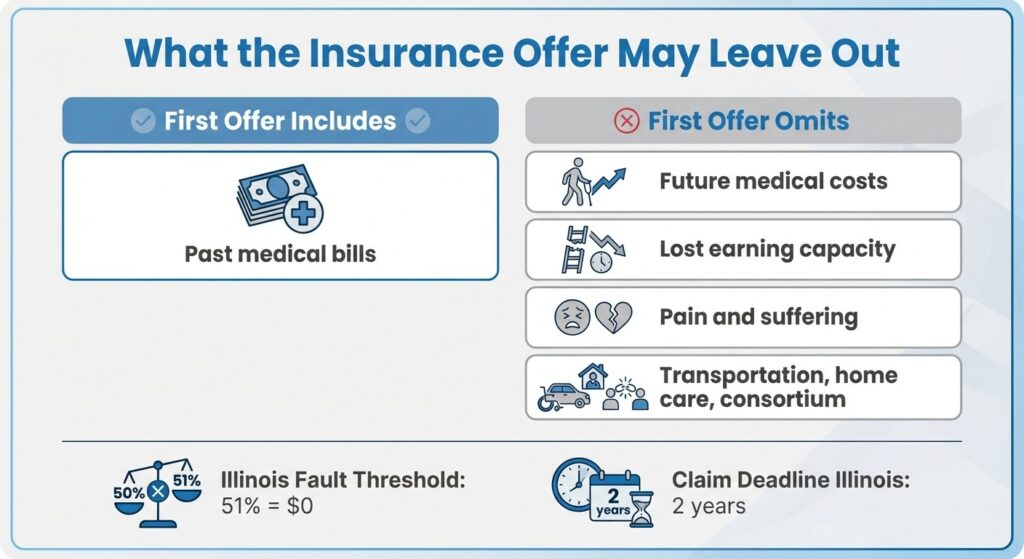
Illinois follows a modified comparative fault system. Here’s what that means in practice:

  • Your compensation is reduced by your percentage of fault
  • At 20% fault, you recover 80% of your damages
  • At 51% fault or more, you recover nothing

Insurance companies will often raise fault as a negotiating lever. They’ll suggest you were partially responsible — you weren’t watching where you were walking, you were following too closely — in order to justify a lower offer. Sometimes that argument has merit. Often it’s a tactic.

If the adjuster is citing your comparative fault as a reason for a reduced offer, you need to understand the actual evidence behind that claim. Witness statements, surveillance footage, police reports, and accident reconstruction all factor in. Don’t accept a fault percentage as given without understanding where it came from.

One more timing consideration worth knowing: Illinois has a two-year statute of limitations for most personal injury claims. That’s your window to file a lawsuit if negotiations break down. It’s long enough that you don’t need to panic — but knowing that deadline exists gives you negotiating leverage. You’re not forced to accept a bad offer just because you feel like the clock is running out.

Before You Respond to Any Offer: A Checklist

You’re not being difficult for asking what you’re owed. You’re doing exactly what any reasonable person should do after an injury that wasn’t their fault.

Work through these questions honestly before you respond to anything:

  1. Have I reached maximum medical improvement? If not, you don’t know your full medical costs yet.
  2. Have lost wages been calculated — including future earning capacity? Not just days missed, but long-term impact.
  3. Has pain and suffering been addressed in a way that reflects my actual experience? Or is it a token number?
  4. Does the offer include all compensable categories? Or only the ones the adjuster chose to mention?
  5. Has fault been assigned, and if so, what evidence supports that percentage?
  6. Am I being pressured to respond before I have complete information?

If you can’t answer those questions confidently, that’s not a personal failing. It means you need more information before making a decision that can’t be undone.

What to Do Right Now

The practical path forward isn’t complicated, but it requires discipline.

Gather your documentation first. Medical records and bills to date, pay stubs or employer statements for missed work, and a plain-language account of how this injury has affected your daily life. That last piece — written in your own words, specific and honest — is more valuable than most people realize. It’s the foundation of any negotiation.

Hold the line on timing. If the offer came before your treatment is complete, tell the adjuster you’re not in a position to settle until you’ve reached maximum medical improvement. That’s a legitimate, defensible position. If they push back, that’s information too — it tells you something about how they’ve assessed your claim.

Recognize pressure for what it is. Urgency from an adjuster is a tactic, not a deadline. The only real deadline is the statute of limitations, and you have two years in Illinois. The adjuster’s timeline serves the insurer’s interests, not yours.

Some claims are straightforward. The injuries are minor, the liability is clear, and a fair settlement can be reached without extended negotiation. But you need to be able to tell the difference between a fair offer and a fast one. Those are not the same thing.

If the numbers feel wrong, or the pressure feels disproportionate, or you’re simply not sure whether what’s on the table reflects what you’re actually owed — that’s the moment to have a conversation with someone who can look at the specifics of your claim. Not to hand it over. Just to understand what you’re looking at before you decide.

The offer on the table is a starting point. Whether it’s also a fair ending point is a question worth answering before you sign.


Facebooktwitterredditpinterestlinkedinmail

The Gear Saved Your Life. Now It’s About to Be Used Against You

Here’s the thing nobody tells you before you file a claim: the helmet that kept you alive may become the first tool an insurance adjuster uses to shrink your settlement. I’ve watched it happen from both sides of the table—first as a bodily-injury adjuster, now working inside a plaintiff-side personal injury attorney team here in North Carolina. The script is almost always the same.

You wore your gear. You survived. And suddenly the conversation shifts from “what did this crash do to you” to “well, you walked away, didn’t you?”

You didn’t walk away. You survived. There’s a difference, and that difference is worth fighting for.

The Myth That Protective Gear Makes Your Injuries Less Real

Let me knock this down first because it’s the one that does the most damage before a rider ever talks to an attorney.

The myth goes like this: if you were wearing a quality helmet and riding jacket, and you didn’t leave the scene in an ambulance, then your injuries must not be that serious. Insurers don’t say this out loud—they’re smarter than that—but they build it into their evaluation. They look at your gear, note that you were “properly equipped,” and use it as a baseline argument that your body was protected, therefore your damages are limited.

This is backwards.

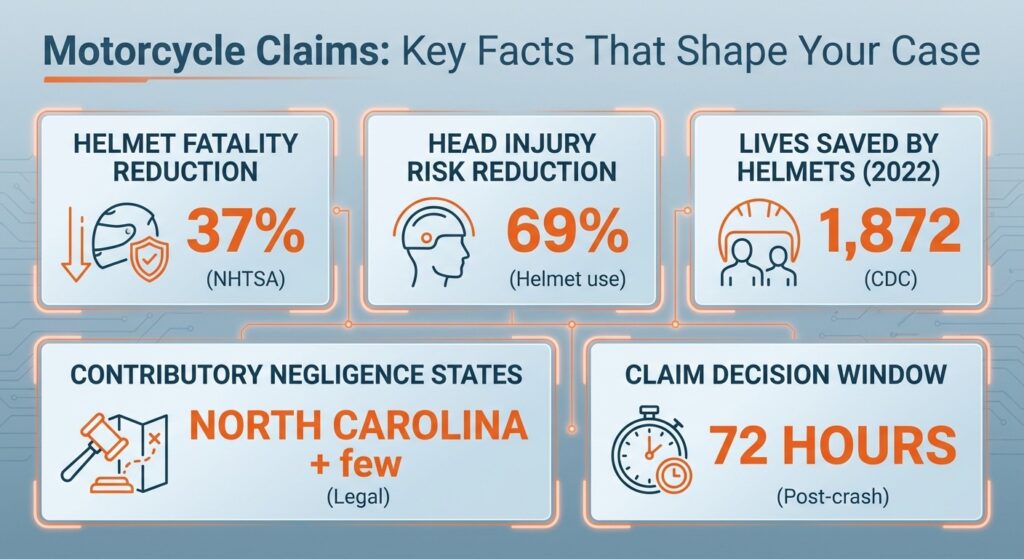
Protective gear reduces the severity of injury. It does not eliminate injury. A helmet absorbs rotational and linear impact forces—federal safety research shows helmets are roughly 37% effective at preventing fatal injuries for operators—but “prevented death” is not the same as “prevented harm.”  Riders who wear full gear still walk away with fractured collarbones, torn rotator cuffs, herniated discs, traumatic brain injuries that don’t show on an ER scan, and PTSD that doesn’t surface for weeks.

The gear did its job. That doesn’t mean your body didn’t pay a price.

What’s also true, and what adjusters quietly know, is that the same helmet effectiveness data that shows helmets reduce head injury risk by about 69% also confirms that riders are still getting hurt—just less catastrophically. Less catastrophic is not the same as uninjured. When you understand that distinction, you stop letting anyone reframe your survival as proof that you’re fine.

How Protective Gear Actually Functions Inside a Claim

Your gear serves two distinct legal functions in a motorcycle injury claim. Most riders only think about one of them.

Legal FunctionWhat It DemonstratesWhy It Matters
Conduct evidenceYou operated responsiblyRebuts contributory/comparative fault arguments
Physical crash evidenceThe forces your body absorbedSupports injury severity narrative

First, it speaks to your conduct. Wearing a DOT-certified helmet, riding jacket, gloves, and boots demonstrates that you were operating responsibly. That matters enormously in states like North Carolina that use contributory negligence, and it matters in comparative negligence states too. If the defense is going to argue you contributed to your own injuries, your gear is your first line of rebuttal.

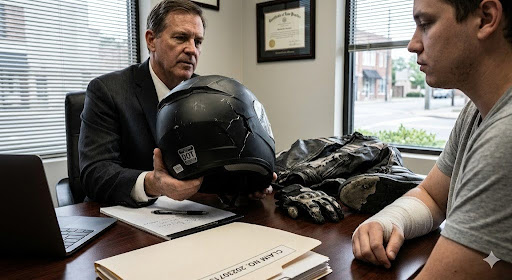
Second, your gear is physical evidence of the crash’s severity. A cracked helmet shell, shredded jacket leather, or ground-down boot toe tells a story that photographs of the road can’t fully capture. That damage is a record of the forces your body absorbed. A boston motorcycle accident attorney or any experienced plaintiff-side counsel will tell you the same thing: preserve that gear, photograph it immediately, and never let it get cleaned, repaired, or discarded before your case resolves.

Contributory vs. Comparative: Why the State You’re In Changes Everything

Here’s where state law creates a fork in the road—and the contrast is stark enough to change your entire strategy.

In a comparative negligence state (say, South Carolina just across the border): if a jury finds you 20% at fault for a crash, you recover 80% of your damages. The insurer may argue your gear reduced your injuries, but they can’t use it to zero out your claim. The fight is about percentages.

In North Carolina’s contributory negligence system: that same 20% finding eliminates your recovery entirely.

This is why adjusters in contributory negligence states sometimes probe harder for any behavior they can pin on the rider—speeding, lane positioning, even whether your gear met current safety standards. They’re not just negotiating a number. They’re hunting for a complete bar to recovery.

North Carolina is one of a handful of states still using pure contributory negligence. Most states use comparative negligence, which reduces your recovery proportionally rather than eliminating it. Knowing which framework applies in your state isn’t optional. It’s the foundation of your entire claim strategy.

This doesn’t mean North Carolina riders are without options. It means the documentation and legal framing have to be airtight from day one.

What Insurance Adjusters Actually Say—and How to Answer It

I spent years on the adjuster side. I know the language. Here’s what you’re likely to hear, translated from claims-speak into plain English.

What they say: “You were wearing a helmet, so the head injury claim seems inconsistent.”What they mean: We’re going to challenge causation. Your answer: Get a neurologist, not just an ER physician. Concussions and traumatic brain injuries are notoriously underdiagnosed in emergency settings. A specialist’s documentation breaks this argument.

What they say:“Your gear shows minimal damage, so the impact couldn’t have been that severe.”What they mean: We’re going to use your gear against your injury narrative. Your answer: Gear damage and injury severity don’t have a linear relationship. A rider thrown at 35 mph onto pavement can sustain serious soft tissue and spinal injuries while the jacket shows only surface abrasion. Biomechanical experts exist specifically to explain this to juries.

What they say:“You were back on your feet at the scene, so…”Stop right there. Adrenaline is real. Delayed-onset injuries are real. The fact that helmets saved an estimated 1,872 lives in 2022 alone tells you something about the forces involved in motorcycle crashes—forces that don’t always announce themselves in the first hour.

The pattern in all of these is identical: the adjuster is trying to use your responsible behavior as a ceiling on your damages. A skilled personal injury attorney recognizes this framing immediately and builds the counter-narrative before the adjuster can cement it.

The 72-Hour Window: What You Do Now Shapes Everything Later

The decisions you make in the first three days after a crash determine the strength of your claim. Here’s the sequence that matters.

At the scene Photograph your gear before anything is moved or removed—helmet, jacket, gloves, boots, all of it. Get photos of the road, the other vehicle, skid marks, and debris. Collect witness contact information before anyone leaves. Do not give a recorded statement to any insurance company, yours or theirs, without legal counsel present.

At the hospital Tell every provider exactly what happened and exactly where you hurt. Don’t minimize symptoms because you feel like you “should” be worse off. Soft tissue pain, headaches, neck stiffness, difficulty concentrating—all of it gets documented. What doesn’t appear in the medical record effectively doesn’t exist in a claim.

Your gear Do not wash it, repair it, or throw it away. Store it somewhere undisturbed. If your helmet cracked or deformed, that crack is evidence. The foam liner compressed? That compression tells a story about impact force that no photograph of the road can replicate.

Legal consultation Talk to a personal injury attorney before you talk to any adjuster about settlement. This isn’t about being litigious—it’s about understanding what your claim is actually worth before someone offers you a number designed to close the file fast. Most motorcycle injury attorneys work on contingency, meaning you pay nothing unless they recover for you.

Your own insurance Understand your uninsured/underinsured motorist coverage before you need it. If the at-fault driver has minimal coverage and your injuries are serious, your own UM/UIM policy may be the most important coverage in the equation.

Quick Answers to What Riders Ask Me Most

Does wearing a helmet hurt my claim if I still got a head injury? No. It demonstrates responsible conduct and actually supports your credibility. The argument that “you wore a helmet so you can’t really be hurt” is a bad-faith framing, and experienced counsel shuts it down with medical evidence.

Can the insurance company argue I should have worn better gear? In some states, yes—they can argue your gear choice contributed to your injury severity. This is a comparative fault argument, and it’s more viable in states with comparative negligence frameworks. Documentation of your gear’s safety certifications matters here.

What if I wasn’t wearing a helmet in a state that doesn’t require one? This is where state law gets complicated fast. Even in states without a universal helmet law, the defense may argue that your choice not to wear one contributed to your head or neck injuries. It doesn’t necessarily bar your claim, but it creates a comparative fault exposure you’ll need to address directly with your attorney.

Before You Talk to Anyone, Do These Things

Four actions. Do them now, before any adjuster calls.

  1. Photograph your gear—every piece, every angle, every scuff and crack.
  2. Write down everything you remember about the crash while it’s fresh: road conditions, speed, what the other driver did, what you felt in the seconds after impact.
  3. Get to a doctor even if you feel “okay,” and tell them everything. Every symptom. Every location.
  4. Call a personal injury attorney who handles motorcycle cases specifically before you accept any settlement call.

Your gear protected your body. Now you need to protect your claim. The knowledge of how this process actually works is the second layer of armor—and it doesn’t weigh an ounce.

Facebooktwitterredditpinterestlinkedinmail

How To File A Lawsuit After A Crane Accident

A Simple Guide in Filing a Lawsuit on A Crane Accident

While there are many types of work-related accidents, crane accidents can also cause serious injuries and damages. Filing a lawsuit can help you get compensation for your losses if you get involved with such.

Seeking Medical Attention and Documentation

Your health should be your top priority, thus, you must make sure to get medical help right away, even if you think your injuries are minor. Keep all medical records and bills, as they will be important for your case. In the aftermath of a crane accident, prioritizing your health and gathering evidence is crucial. A personal injury lawyer in Hudson Valley can guide you through the complexities of filing a lawsuit, ensuring you receive the compensation you’re entitled to for your injuries and losses.

Collect as much information as possible about the accident as well. Take pictures of the scene, the crane, and your injuries. Write down everything you remember about what happened and get the contact information of any witnesses who saw the accident. Make sure to inform your employer or site supervisor.

Contact a Lawyer and Investigate the Accident

Hiring a lawyer who specializes in crane accidents or personal injury cases is crucial. They can help you understand your rights and guide you through the legal process. They will help you investigate the accident and they can work with experts to determine what caused the accident and who is responsible.

Filing and Negotiation of Claims

Your lawyer will help you file a claim with the responsible party or its  insurance company. This claim will detail your injuries, the medical treatment you received, lost wages, and other damages. If they offer a settlement, your lawyer will negotiate on your behalf to get the best possible compensation. Most cases are settled out of court, but if a fair agreement cannot be reached, you can opt to file a lawsuit.

Filing the Lawsuit

If a settlement is not possible, your lawyer will help you file a lawsuit. This involves submitting legal documents to the court that outline your case. He will handle the legal paperwork and represent you in court. The legal process for this can include discovery, depositions, and court hearings. Your lawyer will prepare you for each step and keep you informed throughout the process.

If your case goes to trial, your lawyer will present your case to the judge or jury. The court will decide the amount of compensation you should receive if you win the case. 

Taken together, filing a lawsuit after a crane accident can be complicated, but having a good lawyer can make the process smoother because he is there to help you get the compensation you deserve and will guide you through the entire process.

Facebooktwitterredditpinterestlinkedinmail

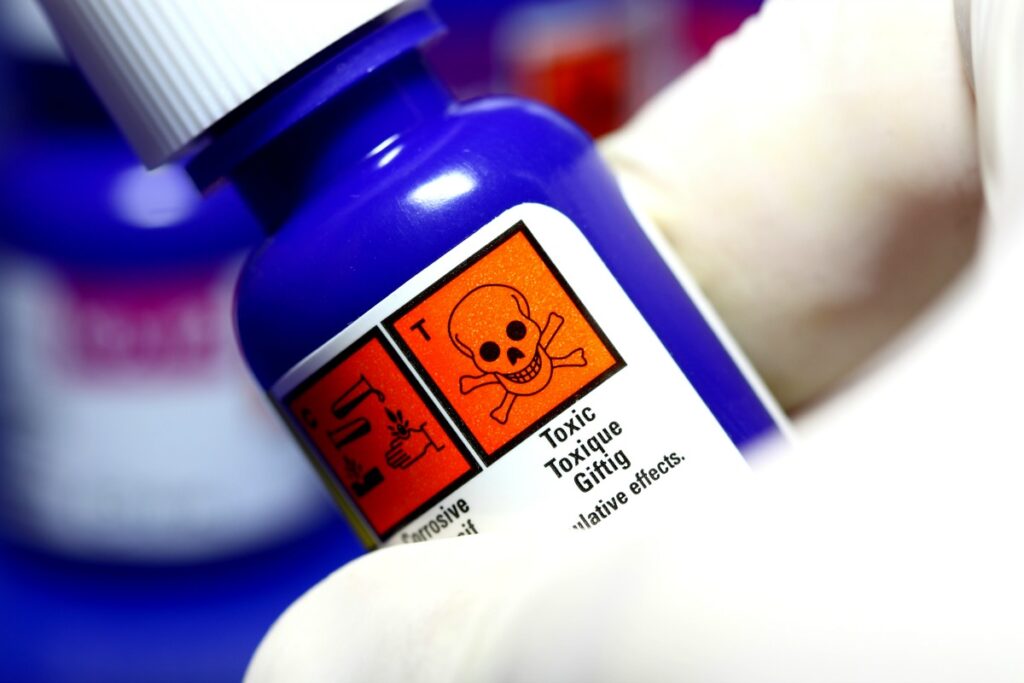
Do People Ever Win Lawsuits Over Exposure To Toxic Materials?

Lawsuit on Exposure to Toxic Material

This kind of lawsuit is one of the most challenging lawsuits. Most of these include big companies who have all the resources to fight against a person or communities’ claims. But what is exposure to toxic material? This happens when a person or community is exposed to a chemical or other similar harmful substance which causes serious damage to one’s health or causes health problems to the people in a given community. In Warwick, facing the aftermath of toxic exposure requires a steadfast ally. Look to a personal injury law firm in Warwick for unwavering support and legal prowess, ensuring your voice is heard and justice is served against corporate giants.

Many people already sought justice for the long-term detriments of toxic exposure, and since these lawsuits involve big companies, it is also important that one hires an expert and experienced lawyer to fight the claim.

Some High Profile Cases on Exposure to Toxic Materials

There have been numerous high-profile cases where individuals or groups have successfully sued companies over exposure to toxic substances. One of the most famous cases is that of Erin Brockovich, who in the 1990s helped residents of Hinkley, California, win a 333 million dollar settlement from Pacific Gas and Electric (PG&E). The lawsuit was filed because PG&E had contaminated the town’s water supply with hexavalent chromium, a carcinogenic substance.

Another significant case involved the residents of Anniston, Alabama, who sued Monsanto Company over the contamination of their community with polychlorinated biphenyls (PCBs). In 2003, Monsanto and its spin-off company, Solutia, agreed to a 700 million dollar settlement to compensate the victims and fund cleanup efforts.

How to Win

There are a lot of aspects which the plaintiff must consider in order to successfully claim compensation and justice from the perpetrators. Some of which include the following:

  • Causation and Proof of Harm;
  • Negligence and Liability; and
  • Strict Liability.

It is important for the plaintiffs to prove that the toxic exposure directly caused their injuries or health issues. Plaintiffs must also demonstrate that the defendant was negligent in their handling, disposal, or manufacturing of the toxic substance which caused their exposure to said toxic substance. The plaintiff can present evidence or testimonies which proves that the company failed to follow safety regulations, ignored warnings about the dangers of the substance, or did not adequately inform the public about the risks. 

Many of these kinds of lawsuits are class action as these legal frameworks allow large groups of individuals affected by the same issue to pool their resources and present a united front. Nonetheless, while winning a lawsuit over exposure to toxic materials can be challenging, a lot of cases have already demonstrated that it is possible.

Facebooktwitterredditpinterestlinkedinmail

How Much Does It Cost To Hire A Personal Injury Lawyer?

The Aftermath of a Personal Injury

Personal injuries can happen to anyone anywhere. There could be an endless reason or risk which can put someone’s life to danger and tragically result in an injury. The person not only has to suffer the physical pain, but also the financial burdens it costs to cover for the hospitalization and for the medicine. Notwithstanding the degree of cautiousness most people observe, sometimes, one could just be a victim of someone else’s recklessness or negligence.

Best Personal Injury Attorney

Understanding the Costs

Calculating the expenses of a personal injury can be overwhelming especially to the person who is just a victim of someone else’s carelessness. Most people suffer more than just a limb pain, the medical bills, and the time off your job which can significantly result in lost wages are another thing people worry about when they suffer personal injuries.

Understanding the costs of the injury helps the injured or the victims explore their options and make an informed decision regarding their situation. Thus, most of these personal injury victims opt to hire a personal injury lawyer to help and guide them recover their losses.

Different Rates for Legal Fees

A lot of these people who suffered said injuries ask their lawyers first on the payment terms and acceptance fee for their case. Reality then hits them harder than most legal fees are actually more costly than they have perceived initially. However, not all personal injury lawyers offer the same rates and terms.

Contingency fee payment arrangement is one of the most common and popular payment structures when one chooses to hire a personal injury lawyer. This means that the lawyer will accept and represent the injured in litigation but he will not get paid unless he or she wins the case. Most often than not, the fee of the lawyer is a portion of the award on damages granted by the court to the victim.

The percentage will depend on the agreed rate between the lawyer and the victim, but mostly up to 25 – 40% of the award. While this is a good scheme in order to ensure that the lawyer’s interest in the case is almost at par with the victim’s. However, one must bear in mind that in contingency fee payment arrangements, a significant portion of the victim’s compensation will go to legal fees.

There are also those lawyers who offer hourly rates which can range between 100 US dollars to 500 US dollars, and even flat rates depending on the complexity of the case presented and the lawyer’s experience and location. 

Ultimately, one must bear in mind that investing in a competent personal injury lawyer can provide the support and expertise necessary to get your claim successfully.

In the midst of personal injury challenges, Hudson Valley law firms stand as pillars of support, offering expert legal counsel to navigate the complexities of personal injury claims and secure the compensation victims need for recovery and stability.

Facebooktwitterredditpinterestlinkedinmail

The Most Common Construction Accidents, And How To Avoid Them

Construction as the Most Common Labor Job

Construction is one of the most popular jobs in the world. This is because construction is the very foundation of the present infrastructure every country in the world has. All famous buildings, sites, and even parks are byproducts of construction labor.

Being one of the most common jobs, construction also has the most common accidents while being in the job. A lot of construction accidents result from company negligence such as lack of safety gears, structures, non-observance of safety protocols, equipment malfunction, and such other things which lead to construction injuries. Faced with a construction accident due to company negligence? Hudson Valley construction accident attorneys are here to fight for your rights, ensuring you get the compensation you deserve for your injuries.

Some of the Most Common Construction Accidents

Being struck by falling objects can be one of the most common causes of construction injuries, some even get struck while those objects are flying or swinging. These things can also be anything, from tools, debris, or any other material which are not properly secured. Electrocution is also a significant risk on construction sites. Working in the field involves the presence of live wires, electrical equipment, and power lines. When these things are not properly checked or conditioned, it could actually lead to electricity-related construction accidents.

There are injuries which the workers experience gradually due to lifting heavy objects repeatedly and doing hard labor on a  daily basis. Such eventually results in fatigue, muscle strain, and physical stress. One can also be trapped to machines like elevators or generators, and other similar equipment. These accidents are common most especially to construction sites which observe poor safety protocols.

How to Prevent Construction Accidents

Ensuring that all equipment is secure and in good condition, and that workers receive adequate training on accident prevention techniques, can significantly reduce the risk of these accidents happening in a construction environment.

To prevent electrocutions, companies must ensure that all electrical installations comply with safety standards and are regularly inspected. In addition to that, safety officers and even workers must undergo adequate training in order for them to know the basics regarding electricity installation and prevent any construction accidents in the future.

Companies and their workers must understand how to address the most common accidents in a construction site. Understanding and addressing these accidents are the key to improving workplace safety. By implementing appropriate safety measures, providing thorough training, and fostering a culture of awareness, construction sites can significantly reduce the risk of accidents and create a safer working environment for all employees.

Facebooktwitterredditpinterestlinkedinmail

What Is A Wrongful Death Lawsuit, And When Should You File One?

Wrongful Death Lawsuits

It is a kind of lawsuit wherein a family member of the family of the deceased seeks justice on his or her death on the ground that the death was caused by another person’s negligence. Most of these occur in professional settings. Hence, family members file these types of suits in order to attain justice and financial indemnification for the loss.

This type of lawsuit is a civil action brought against a person, company, or entity whose negligent or intentional actions led to someone else’s death. Most of these suits are brought by the family members of those who died of such causes, unlike criminal cases, which are prosecuted by the state and can result in imprisonment or fines, it can also be pursued by the estate of the deceased. The primary purpose is to seek monetary compensation for the losses suffered due to the untimely death. Seeking justice for a loved one’s untimely death due to negligence? Hudson Valley law office specializes in wrongful death lawsuits, providing compassionate support and legal expertise to secure the compensation families deserve.

Grounds for Filing a the Lawsuit

Several situations can give rise to this type of lawsuit, including:

  • Medical Malpractice;
  • Automobile Accidents;
  • Workplace Accidents;
  • Defective Products;
  • Criminal Actions.

Who Can File a Wrongful Death Lawsuit?

The right to file a wrongful death lawsuit typically belongs to close family members of the deceased, such as spouses, children, and parents. In some jurisdictions, extended family members or the deceased’s estate representative may also have the legal standing to file a claim. The specific laws governing who can file can differ by state, so it is crucial to consult with a legal professional to understand your rights as the family member of the deceased.

Types of Compensation

These lawsuit aims to compensate the deceased’s family for the  losses, such as medical expenses, funeral and burial costs, Income lost, compensation for the emotional suffering of the surviving family members, and such other damages which the family claims before the court.

When to Consider Filing a Wrongful Death Lawsuit

One should consider filing this kind of lawsuit if you believe that your loved one’s death was caused by someone else’s negligence or recklessness. It is thus essential to consult with an experienced attorney for such cases who can evaluate your case, explain your legal options, and guide you through the process. They can significantly help gather evidence, negotiate with insurance companies, and represent your interests in court if necessary.

It is important to understand what a wrongful death lawsuit entails. Seeking justice for your loved one can not only provide financial support but also hold responsible parties accountable, potentially preventing similar tragedies in the future.

Facebooktwitterredditpinterestlinkedinmail

Can You Sue A Team If You’re Hurt At A Game While A Spectator?

Assumption of Risk Doctrine

A live sports event is a very common leisure for a lot of people, especially those who are sports fans, but it can also come with several unexpected risks. These spectators might find themselves in the path of a baseball, a rogue hockey puck, or even an overzealous fan.

One of the primary legal doctrines in these cases is the “assumption of risk”. This doctrine provides that when a person or individual buys a ticket to watch a certain sporting event, they accept the inherent risk of being projected by a baseball being hit by a home runner or a basketball player who jumps way too hard to catch the ball. Courts often uphold this doctrine, thus making it difficult to claim negligence on the part of the team or stadium operators for injuries caused by the sport itself. Injured at a live sports event? Contact a personal injury lawyer in Warwick to navigate the complexities of assumption of risk and pursue rightful compensation for your injuries amidst the excitement of the game.

Negligence and Duty of Care

However, the assumption of risk doctrine does not shield stadium operators from liability. They are still required to maintain a certain standard of care to ensure the safety and avoid sports spectator injury during the game. This includes the following:

  •  installing protective netting;
  • providing adequate security; and
  • ensuring that the facilities are safe and well-maintained.

If a sports spectator is injured due to the carelessness of the administrator in a stadium, it can be considered as grounds for a claim. Such as when ineffectively kept up structures are the cause of  these incidents.

In some cases, sports spectator injury might be caused by defective products. sIt can be because of  faulty seats or railings. If such is the case, product liability laws could come into play. If it is proven that a defective product caused the injury, the manufacturer, and potentially the team or stadium, could be held liable.

For these types of cases, consulting with a personal injury attorney is crucial to determine the viability of a case. Having a lawyer can greatly help and guide you through your case and make you understand the possibilities as well as the consequences when you decide to pursue the claim.

While the assumption of risk doctrine provides significant protection for teams and stadium operators, it is not absolute. Spectators have the right to expect a reasonable level of safety. Some injuries can be attributed to negligence or a preventable issue, hence seeking legal advice is a prudent step.

Facebooktwitterredditpinterestlinkedinmail

Should You Call A Lawyer If You’re Hurt In A Motorcycle Accident?

Most Common Road Accident

One of the most frequent causes of road injuries people experience practically every day is motorcycle accident. The first person you should contact if you are hurt in this kind of accident is a lawyer because a legal expert can have a big impact on your recovery and future, so it is imperative to ask for their guidance.

A lawyer that specializes in this field is familiar with the existing traffic laws, insurance policies, and personal injury claims. These accidents involve a multitude of legal complexities. Injured in a motorcycle accident? Hudson Valley personal injury lawyers specialize in navigating the complexities of traffic laws and insurance claims, ensuring victims receive the guidance needed for a successful recovery and future stability.

They can guide you through and make sure you don’t overlook any important details that might have an impact on your case.

Determining who is at fault in these kinds of accidents requires gathering evidence, interviewing witnesses, and sometimes reconstructing the accident scene. A lawyer has the resources and expertise to conduct a thorough investigation to establish liability. Insurance companies are also notorious for minimizing payouts. An experienced lawyer can handle all communications with insurance companies, ensuring that your rights are protected because they will negotiate on your behalf to secure a fair settlement that covers your medical expenses, lost wages, pain and suffering, and other damages.

Understanding the Full Extent of One’s Injuries

Some injuries sustained in motorcycle accidents may not be immediately apparent. A lawyer will ensure that you receive a thorough medical evaluation to document all your injuries. They can help you connect with medical professionals who specialize in treating accident victims, ensuring that you get the comprehensive care you need. This documentation is crucial for building a robust case and ensuring that you receive full compensation for both current and future medical needs.

Maximizing Compensation and Peace of Mind

A lawyer will fight to maximize your compensation by considering all potential damages. This includes not only medical bills and lost income but also pain and suffering, emotional distress, loss of enjoyment of life, and any long-term disabilities. They will present a compelling case to ensure that you are fully compensated for the impact of the accident on your life.

Hiring a lawyer after a motorcycle accident  gives you peace of mind knowing that a knowledgeable professional is handling the legal aspects of your case and allows you to focus on your recovery. It alleviates the stress of dealing with paperwork, insurance adjusters, and legal deadlines.

In the aftermath of this accident, the physical and emotional toll can be overwhelming. By calling a lawyer, you ensure that your legal rights are protected, and you receive the compensation you deserve. Their expertise in handling the complexities of your case allows you to focus on healing and rebuilding your life.

Facebooktwitterredditpinterestlinkedinmail