Category: Accidents

The Gear Saved Your Life. Now It’s About to Be Used Against You

Here’s the thing nobody tells you before you file a claim: the helmet that kept you alive may become the first tool an insurance adjuster uses to shrink your settlement. I’ve watched it happen from both sides of the table—first as a bodily-injury adjuster, now working inside a plaintiff-side personal injury attorney team here in North Carolina. The script is almost always the same.

You wore your gear. You survived. And suddenly the conversation shifts from “what did this crash do to you” to “well, you walked away, didn’t you?”

You didn’t walk away. You survived. There’s a difference, and that difference is worth fighting for.

The Myth That Protective Gear Makes Your Injuries Less Real

Let me knock this down first because it’s the one that does the most damage before a rider ever talks to an attorney.

The myth goes like this: if you were wearing a quality helmet and riding jacket, and you didn’t leave the scene in an ambulance, then your injuries must not be that serious. Insurers don’t say this out loud—they’re smarter than that—but they build it into their evaluation. They look at your gear, note that you were “properly equipped,” and use it as a baseline argument that your body was protected, therefore your damages are limited.

This is backwards.

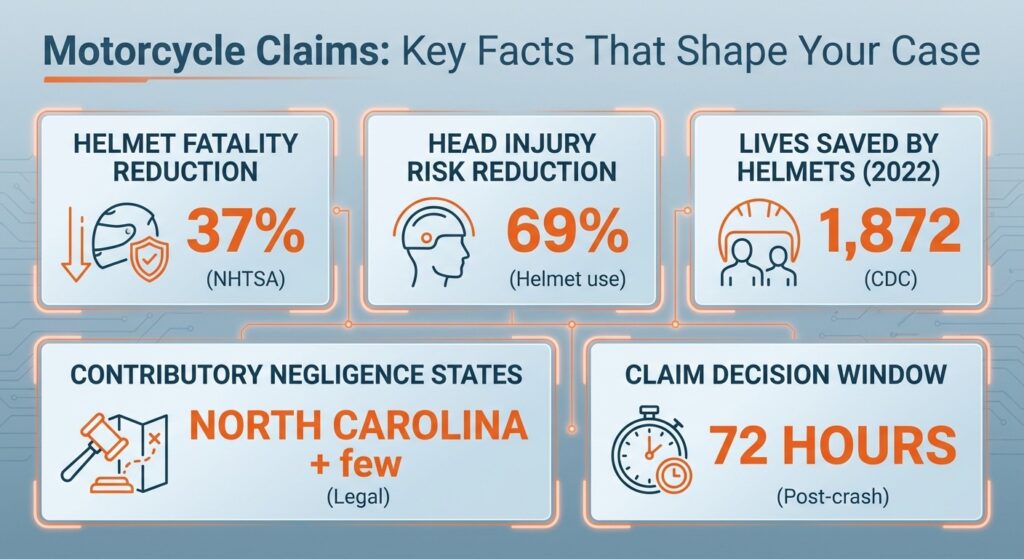
Protective gear reduces the severity of injury. It does not eliminate injury. A helmet absorbs rotational and linear impact forces—federal safety research shows helmets are roughly 37% effective at preventing fatal injuries for operators—but “prevented death” is not the same as “prevented harm.”  Riders who wear full gear still walk away with fractured collarbones, torn rotator cuffs, herniated discs, traumatic brain injuries that don’t show on an ER scan, and PTSD that doesn’t surface for weeks.

The gear did its job. That doesn’t mean your body didn’t pay a price.

What’s also true, and what adjusters quietly know, is that the same helmet effectiveness data that shows helmets reduce head injury risk by about 69% also confirms that riders are still getting hurt—just less catastrophically. Less catastrophic is not the same as uninjured. When you understand that distinction, you stop letting anyone reframe your survival as proof that you’re fine.

How Protective Gear Actually Functions Inside a Claim

Your gear serves two distinct legal functions in a motorcycle injury claim. Most riders only think about one of them.

Legal FunctionWhat It DemonstratesWhy It Matters
Conduct evidenceYou operated responsiblyRebuts contributory/comparative fault arguments
Physical crash evidenceThe forces your body absorbedSupports injury severity narrative

First, it speaks to your conduct. Wearing a DOT-certified helmet, riding jacket, gloves, and boots demonstrates that you were operating responsibly. That matters enormously in states like North Carolina that use contributory negligence, and it matters in comparative negligence states too. If the defense is going to argue you contributed to your own injuries, your gear is your first line of rebuttal.

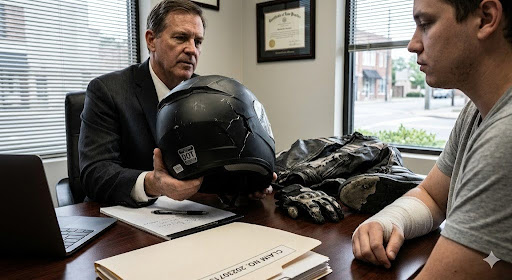
Second, your gear is physical evidence of the crash’s severity. A cracked helmet shell, shredded jacket leather, or ground-down boot toe tells a story that photographs of the road can’t fully capture. That damage is a record of the forces your body absorbed. A boston motorcycle accident attorney or any experienced plaintiff-side counsel will tell you the same thing: preserve that gear, photograph it immediately, and never let it get cleaned, repaired, or discarded before your case resolves.

Contributory vs. Comparative: Why the State You’re In Changes Everything

Here’s where state law creates a fork in the road—and the contrast is stark enough to change your entire strategy.

In a comparative negligence state (say, South Carolina just across the border): if a jury finds you 20% at fault for a crash, you recover 80% of your damages. The insurer may argue your gear reduced your injuries, but they can’t use it to zero out your claim. The fight is about percentages.

In North Carolina’s contributory negligence system: that same 20% finding eliminates your recovery entirely.

This is why adjusters in contributory negligence states sometimes probe harder for any behavior they can pin on the rider—speeding, lane positioning, even whether your gear met current safety standards. They’re not just negotiating a number. They’re hunting for a complete bar to recovery.

North Carolina is one of a handful of states still using pure contributory negligence. Most states use comparative negligence, which reduces your recovery proportionally rather than eliminating it. Knowing which framework applies in your state isn’t optional. It’s the foundation of your entire claim strategy.

This doesn’t mean North Carolina riders are without options. It means the documentation and legal framing have to be airtight from day one.

What Insurance Adjusters Actually Say—and How to Answer It
I spent years on the adjuster side. I know the language. Here’s what you’re likely to hear, translated from claims-speak into plain English.

What they say: “You were wearing a helmet, so the head injury claim seems inconsistent.”What they mean: We’re going to challenge causation. Your answer: Get a neurologist, not just an ER physician. Concussions and traumatic brain injuries are notoriously underdiagnosed in emergency settings. A specialist’s documentation breaks this argument.

What they say:“Your gear shows minimal damage, so the impact couldn’t have been that severe.”What they mean: We’re going to use your gear against your injury narrative. Your answer: Gear damage and injury severity don’t have a linear relationship. A rider thrown at 35 mph onto pavement can sustain serious soft tissue and spinal injuries while the jacket shows only surface abrasion. Biomechanical experts exist specifically to explain this to juries.

What they say:“You were back on your feet at the scene, so…”Stop right there. Adrenaline is real. Delayed-onset injuries are real. The fact that helmets saved an estimated 1,872 lives in 2022 alone tells you something about the forces involved in motorcycle crashes—forces that don’t always announce themselves in the first hour.

The pattern in all of these is identical: the adjuster is trying to use your responsible behavior as a ceiling on your damages. A skilled personal injury attorney recognizes this framing immediately and builds the counter-narrative before the adjuster can cement it.

The 72-Hour Window: What You Do Now Shapes Everything Later

The decisions you make in the first three days after a crash determine the strength of your claim. Here’s the sequence that matters.

At the scene Photograph your gear before anything is moved or removed—helmet, jacket, gloves, boots, all of it. Get photos of the road, the other vehicle, skid marks, and debris. Collect witness contact information before anyone leaves. Do not give a recorded statement to any insurance company, yours or theirs, without legal counsel present.

At the hospital Tell every provider exactly what happened and exactly where you hurt. Don’t minimize symptoms because you feel like you “should” be worse off. Soft tissue pain, headaches, neck stiffness, difficulty concentrating—all of it gets documented. What doesn’t appear in the medical record effectively doesn’t exist in a claim.

Your gear Do not wash it, repair it, or throw it away. Store it somewhere undisturbed. If your helmet cracked or deformed, that crack is evidence. The foam liner compressed? That compression tells a story about impact force that no photograph of the road can replicate.

Legal consultation Talk to a personal injury attorney before you talk to any adjuster about settlement. This isn’t about being litigious—it’s about understanding what your claim is actually worth before someone offers you a number designed to close the file fast. Most motorcycle injury attorneys work on contingency, meaning you pay nothing unless they recover for you.

Your own insurance Understand your uninsured/underinsured motorist coverage before you need it. If the at-fault driver has minimal coverage and your injuries are serious, your own UM/UIM policy may be the most important coverage in the equation.

Quick Answers to What Riders Ask Me Most

Does wearing a helmet hurt my claim if I still got a head injury? No. It demonstrates responsible conduct and actually supports your credibility. The argument that “you wore a helmet so you can’t really be hurt” is a bad-faith framing, and experienced counsel shuts it down with medical evidence.

Can the insurance company argue I should have worn better gear? In some states, yes—they can argue your gear choice contributed to your injury severity. This is a comparative fault argument, and it’s more viable in states with comparative negligence frameworks. Documentation of your gear’s safety certifications matters here.

What if I wasn’t wearing a helmet in a state that doesn’t require one? This is where state law gets complicated fast. Even in states without a universal helmet law, the defense may argue that your choice not to wear one contributed to your head or neck injuries. It doesn’t necessarily bar your claim, but it creates a comparative fault exposure you’ll need to address directly with your attorney.

Before You Talk to Anyone, Do These Things

Four actions. Do them now, before any adjuster calls.

  1. Photograph your gear—every piece, every angle, every scuff and crack.
  2. Write down everything you remember about the crash while it’s fresh: road conditions, speed, what the other driver did, what you felt in the seconds after impact.
  3. Get to a doctor even if you feel “okay,” and tell them everything. Every symptom. Every location.
  4. Call a personal injury attorney who handles motorcycle cases specifically before you accept any settlement call.

Your gear protected your body. Now you need to protect your claim. The knowledge of how this process actually works is the second layer of armor—and it doesn’t weigh an ounce.


Facebooktwitterredditpinterestlinkedinmail

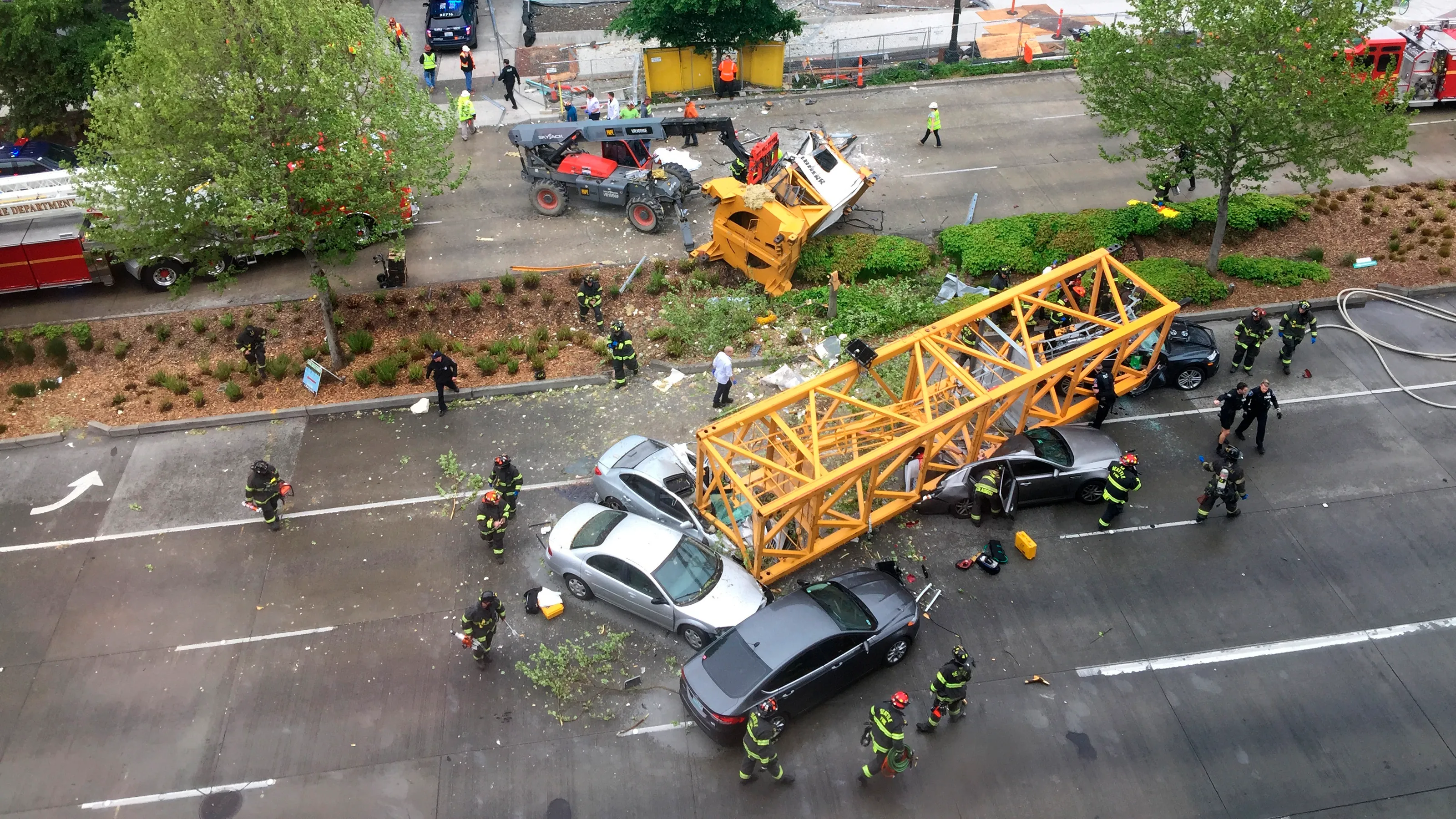
How To File A Lawsuit After A Crane Accident

A Simple Guide in Filing a Lawsuit on A Crane Accident

While there are many types of work-related accidents, crane accidents can also cause serious injuries and damages. Filing a lawsuit can help you get compensation for your losses if you get involved with such.

Seeking Medical Attention and Documentation

Your health should be your top priority, thus, you must make sure to get medical help right away, even if you think your injuries are minor. Keep all medical records and bills, as they will be important for your case. In the aftermath of a crane accident, prioritizing your health and gathering evidence is crucial. A personal injury lawyer in Hudson Valley can guide you through the complexities of filing a lawsuit, ensuring you receive the compensation you’re entitled to for your injuries and losses.

Collect as much information as possible about the accident as well. Take pictures of the scene, the crane, and your injuries. Write down everything you remember about what happened and get the contact information of any witnesses who saw the accident. Make sure to inform your employer or site supervisor.

Contact a Lawyer and Investigate the Accident

Hiring a lawyer who specializes in crane accidents or personal injury cases is crucial. They can help you understand your rights and guide you through the legal process. They will help you investigate the accident and they can work with experts to determine what caused the accident and who is responsible.

Filing and Negotiation of Claims

Your lawyer will help you file a claim with the responsible party or its  insurance company. This claim will detail your injuries, the medical treatment you received, lost wages, and other damages. If they offer a settlement, your lawyer will negotiate on your behalf to get the best possible compensation. Most cases are settled out of court, but if a fair agreement cannot be reached, you can opt to file a lawsuit.

Filing the Lawsuit

If a settlement is not possible, your lawyer will help you file a lawsuit. This involves submitting legal documents to the court that outline your case. He will handle the legal paperwork and represent you in court. The legal process for this can include discovery, depositions, and court hearings. Your lawyer will prepare you for each step and keep you informed throughout the process.

If your case goes to trial, your lawyer will present your case to the judge or jury. The court will decide the amount of compensation you should receive if you win the case. 

Taken together, filing a lawsuit after a crane accident can be complicated, but having a good lawyer can make the process smoother because he is there to help you get the compensation you deserve and will guide you through the entire process.

Facebooktwitterredditpinterestlinkedinmail

The Most Common Construction Accidents, And How To Avoid Them

Construction as the Most Common Labor Job

Construction is one of the most popular jobs in the world. This is because construction is the very foundation of the present infrastructure every country in the world has. All famous buildings, sites, and even parks are byproducts of construction labor.

Being one of the most common jobs, construction also has the most common accidents while being in the job. A lot of construction accidents result from company negligence such as lack of safety gears, structures, non-observance of safety protocols, equipment malfunction, and such other things which lead to construction injuries. Faced with a construction accident due to company negligence? Hudson Valley construction accident attorneys are here to fight for your rights, ensuring you get the compensation you deserve for your injuries.

Some of the Most Common Construction Accidents

Being struck by falling objects can be one of the most common causes of construction injuries, some even get struck while those objects are flying or swinging. These things can also be anything, from tools, debris, or any other material which are not properly secured. Electrocution is also a significant risk on construction sites. Working in the field involves the presence of live wires, electrical equipment, and power lines. When these things are not properly checked or conditioned, it could actually lead to electricity-related construction accidents.

There are injuries which the workers experience gradually due to lifting heavy objects repeatedly and doing hard labor on a  daily basis. Such eventually results in fatigue, muscle strain, and physical stress. One can also be trapped to machines like elevators or generators, and other similar equipment. These accidents are common most especially to construction sites which observe poor safety protocols.

How to Prevent Construction Accidents

Ensuring that all equipment is secure and in good condition, and that workers receive adequate training on accident prevention techniques, can significantly reduce the risk of these accidents happening in a construction environment.

To prevent electrocutions, companies must ensure that all electrical installations comply with safety standards and are regularly inspected. In addition to that, safety officers and even workers must undergo adequate training in order for them to know the basics regarding electricity installation and prevent any construction accidents in the future.

Companies and their workers must understand how to address the most common accidents in a construction site. Understanding and addressing these accidents are the key to improving workplace safety. By implementing appropriate safety measures, providing thorough training, and fostering a culture of awareness, construction sites can significantly reduce the risk of accidents and create a safer working environment for all employees.

Facebooktwitterredditpinterestlinkedinmail

What Is A Wrongful Death Lawsuit, And When Should You File One?

Wrongful Death Lawsuits

It is a kind of lawsuit wherein a family member of the family of the deceased seeks justice on his or her death on the ground that the death was caused by another person’s negligence. Most of these occur in professional settings. Hence, family members file these types of suits in order to attain justice and financial indemnification for the loss.

This type of lawsuit is a civil action brought against a person, company, or entity whose negligent or intentional actions led to someone else’s death. Most of these suits are brought by the family members of those who died of such causes, unlike criminal cases, which are prosecuted by the state and can result in imprisonment or fines, it can also be pursued by the estate of the deceased. The primary purpose is to seek monetary compensation for the losses suffered due to the untimely death. Seeking justice for a loved one’s untimely death due to negligence? Hudson Valley law office specializes in wrongful death lawsuits, providing compassionate support and legal expertise to secure the compensation families deserve.

Grounds for Filing a the Lawsuit

Several situations can give rise to this type of lawsuit, including:

  • Medical Malpractice;
  • Automobile Accidents;
  • Workplace Accidents;
  • Defective Products;
  • Criminal Actions.

Who Can File a Wrongful Death Lawsuit?

The right to file a wrongful death lawsuit typically belongs to close family members of the deceased, such as spouses, children, and parents. In some jurisdictions, extended family members or the deceased’s estate representative may also have the legal standing to file a claim. The specific laws governing who can file can differ by state, so it is crucial to consult with a legal professional to understand your rights as the family member of the deceased.

Types of Compensation

These lawsuit aims to compensate the deceased’s family for the  losses, such as medical expenses, funeral and burial costs, Income lost, compensation for the emotional suffering of the surviving family members, and such other damages which the family claims before the court.

When to Consider Filing a Wrongful Death Lawsuit

One should consider filing this kind of lawsuit if you believe that your loved one’s death was caused by someone else’s negligence or recklessness. It is thus essential to consult with an experienced attorney for such cases who can evaluate your case, explain your legal options, and guide you through the process. They can significantly help gather evidence, negotiate with insurance companies, and represent your interests in court if necessary.

It is important to understand what a wrongful death lawsuit entails. Seeking justice for your loved one can not only provide financial support but also hold responsible parties accountable, potentially preventing similar tragedies in the future.

Facebooktwitterredditpinterestlinkedinmail

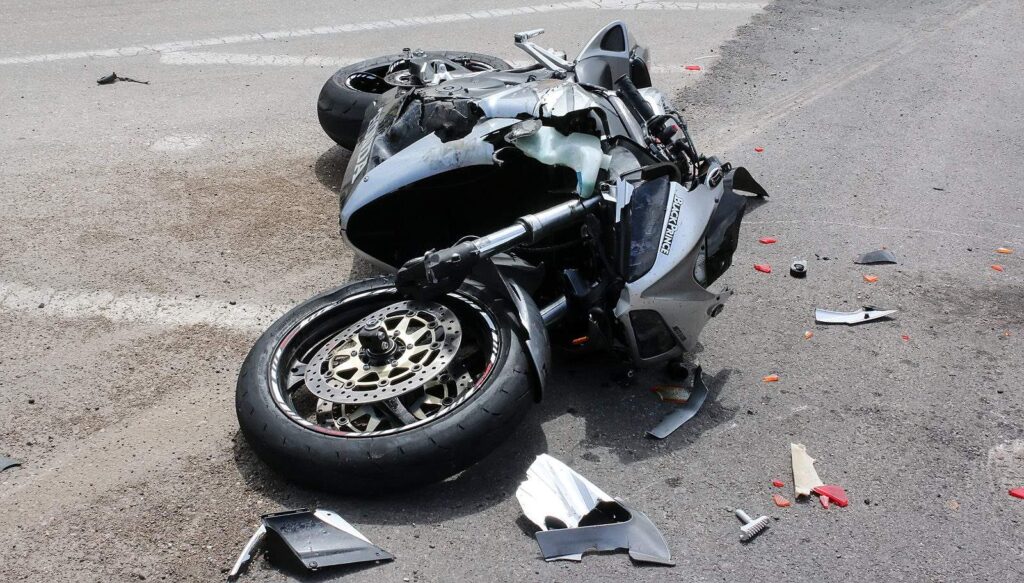
Should You Call A Lawyer If You’re Hurt In A Motorcycle Accident?

Most Common Road Accident

One of the most frequent causes of road injuries people experience practically every day is motorcycle accident. The first person you should contact if you are hurt in this kind of accident is a lawyer because a legal expert can have a big impact on your recovery and future, so it is imperative to ask for their guidance.

A lawyer that specializes in this field is familiar with the existing traffic laws, insurance policies, and personal injury claims. These accidents involve a multitude of legal complexities. Injured in a motorcycle accident? Hudson Valley personal injury lawyers specialize in navigating the complexities of traffic laws and insurance claims, ensuring victims receive the guidance needed for a successful recovery and future stability.

They can guide you through and make sure you don’t overlook any important details that might have an impact on your case.

Determining who is at fault in these kinds of accidents requires gathering evidence, interviewing witnesses, and sometimes reconstructing the accident scene. A lawyer has the resources and expertise to conduct a thorough investigation to establish liability. Insurance companies are also notorious for minimizing payouts. An experienced lawyer can handle all communications with insurance companies, ensuring that your rights are protected because they will negotiate on your behalf to secure a fair settlement that covers your medical expenses, lost wages, pain and suffering, and other damages.

Understanding the Full Extent of One’s Injuries

Some injuries sustained in motorcycle accidents may not be immediately apparent. A lawyer will ensure that you receive a thorough medical evaluation to document all your injuries. They can help you connect with medical professionals who specialize in treating accident victims, ensuring that you get the comprehensive care you need. This documentation is crucial for building a robust case and ensuring that you receive full compensation for both current and future medical needs.

Maximizing Compensation and Peace of Mind

A lawyer will fight to maximize your compensation by considering all potential damages. This includes not only medical bills and lost income but also pain and suffering, emotional distress, loss of enjoyment of life, and any long-term disabilities. They will present a compelling case to ensure that you are fully compensated for the impact of the accident on your life.

Hiring a lawyer after a motorcycle accident  gives you peace of mind knowing that a knowledgeable professional is handling the legal aspects of your case and allows you to focus on your recovery. It alleviates the stress of dealing with paperwork, insurance adjusters, and legal deadlines.

In the aftermath of this accident, the physical and emotional toll can be overwhelming. By calling a lawyer, you ensure that your legal rights are protected, and you receive the compensation you deserve. Their expertise in handling the complexities of your case allows you to focus on healing and rebuilding your life.

Facebooktwitterredditpinterestlinkedinmail