
Here’s the thing nobody tells you before you file a claim: the helmet that kept you alive may become the first tool an insurance adjuster uses to shrink your settlement. I’ve watched it happen from both sides of the table—first as a bodily-injury adjuster, now working inside a plaintiff-side personal injury attorney team here in North Carolina. The script is almost always the same.
You wore your gear. You survived. And suddenly the conversation shifts from “what did this crash do to you” to “well, you walked away, didn’t you?”
You didn’t walk away. You survived. There’s a difference, and that difference is worth fighting for.
The Myth That Protective Gear Makes Your Injuries Less Real
Let me knock this down first because it’s the one that does the most damage before a rider ever talks to an attorney.
The myth goes like this: if you were wearing a quality helmet and riding jacket, and you didn’t leave the scene in an ambulance, then your injuries must not be that serious. Insurers don’t say this out loud—they’re smarter than that—but they build it into their evaluation. They look at your gear, note that you were “properly equipped,” and use it as a baseline argument that your body was protected, therefore your damages are limited.
This is backwards.
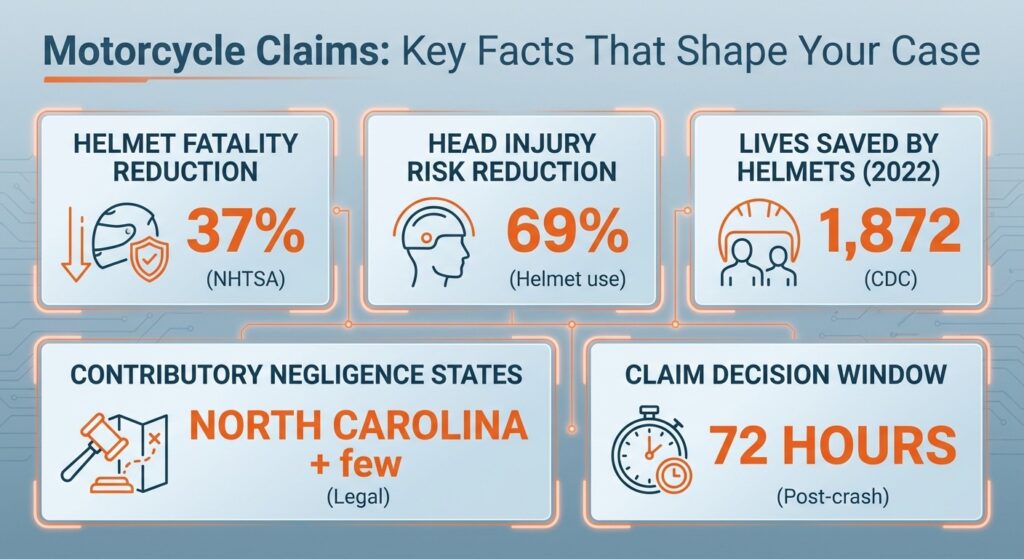
Protective gear reduces the severity of injury. It does not eliminate injury. A helmet absorbs rotational and linear impact forces—federal safety research shows helmets are roughly 37% effective at preventing fatal injuries for operators—but “prevented death” is not the same as “prevented harm.” Riders who wear full gear still walk away with fractured collarbones, torn rotator cuffs, herniated discs, traumatic brain injuries that don’t show on an ER scan, and PTSD that doesn’t surface for weeks.
The gear did its job. That doesn’t mean your body didn’t pay a price.
What’s also true, and what adjusters quietly know, is that the same helmet effectiveness data that shows helmets reduce head injury risk by about 69% also confirms that riders are still getting hurt—just less catastrophically. Less catastrophic is not the same as uninjured. When you understand that distinction, you stop letting anyone reframe your survival as proof that you’re fine.
How Protective Gear Actually Functions Inside a Claim
Your gear serves two distinct legal functions in a motorcycle injury claim. Most riders only think about one of them.
| Legal Function | What It Demonstrates | Why It Matters |
|---|---|---|
| Conduct evidence | You operated responsibly | Rebuts contributory/comparative fault arguments |
| Physical crash evidence | The forces your body absorbed | Supports injury severity narrative |
First, it speaks to your conduct. Wearing a DOT-certified helmet, riding jacket, gloves, and boots demonstrates that you were operating responsibly. That matters enormously in states like North Carolina that use contributory negligence, and it matters in comparative negligence states too. If the defense is going to argue you contributed to your own injuries, your gear is your first line of rebuttal.
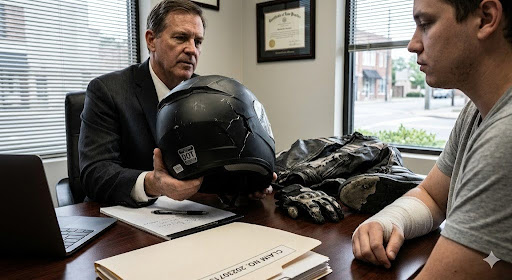
Second, your gear is physical evidence of the crash’s severity. A cracked helmet shell, shredded jacket leather, or ground-down boot toe tells a story that photographs of the road can’t fully capture. That damage is a record of the forces your body absorbed. A boston motorcycle accident attorney or any experienced plaintiff-side counsel will tell you the same thing: preserve that gear, photograph it immediately, and never let it get cleaned, repaired, or discarded before your case resolves.
Contributory vs. Comparative: Why the State You’re In Changes Everything
Here’s where state law creates a fork in the road—and the contrast is stark enough to change your entire strategy.
In a comparative negligence state (say, South Carolina just across the border): if a jury finds you 20% at fault for a crash, you recover 80% of your damages. The insurer may argue your gear reduced your injuries, but they can’t use it to zero out your claim. The fight is about percentages.
In North Carolina’s contributory negligence system: that same 20% finding eliminates your recovery entirely.
This is why adjusters in contributory negligence states sometimes probe harder for any behavior they can pin on the rider—speeding, lane positioning, even whether your gear met current safety standards. They’re not just negotiating a number. They’re hunting for a complete bar to recovery.
North Carolina is one of a handful of states still using pure contributory negligence. Most states use comparative negligence, which reduces your recovery proportionally rather than eliminating it. Knowing which framework applies in your state isn’t optional. It’s the foundation of your entire claim strategy.
This doesn’t mean North Carolina riders are without options. It means the documentation and legal framing have to be airtight from day one.
What Insurance Adjusters Actually Say—and How to Answer It
I spent years on the adjuster side. I know the language. Here’s what you’re likely to hear, translated from claims-speak into plain English.
What they say: “You were wearing a helmet, so the head injury claim seems inconsistent.”What they mean: We’re going to challenge causation. Your answer: Get a neurologist, not just an ER physician. Concussions and traumatic brain injuries are notoriously underdiagnosed in emergency settings. A specialist’s documentation breaks this argument.
What they say:“Your gear shows minimal damage, so the impact couldn’t have been that severe.”What they mean: We’re going to use your gear against your injury narrative. Your answer: Gear damage and injury severity don’t have a linear relationship. A rider thrown at 35 mph onto pavement can sustain serious soft tissue and spinal injuries while the jacket shows only surface abrasion. Biomechanical experts exist specifically to explain this to juries.
What they say:“You were back on your feet at the scene, so…”Stop right there. Adrenaline is real. Delayed-onset injuries are real. The fact that helmets saved an estimated 1,872 lives in 2022 alone tells you something about the forces involved in motorcycle crashes—forces that don’t always announce themselves in the first hour.
The pattern in all of these is identical: the adjuster is trying to use your responsible behavior as a ceiling on your damages. A skilled personal injury attorney recognizes this framing immediately and builds the counter-narrative before the adjuster can cement it.
The 72-Hour Window: What You Do Now Shapes Everything Later
The decisions you make in the first three days after a crash determine the strength of your claim. Here’s the sequence that matters.
At the scene Photograph your gear before anything is moved or removed—helmet, jacket, gloves, boots, all of it. Get photos of the road, the other vehicle, skid marks, and debris. Collect witness contact information before anyone leaves. Do not give a recorded statement to any insurance company, yours or theirs, without legal counsel present.
At the hospital Tell every provider exactly what happened and exactly where you hurt. Don’t minimize symptoms because you feel like you “should” be worse off. Soft tissue pain, headaches, neck stiffness, difficulty concentrating—all of it gets documented. What doesn’t appear in the medical record effectively doesn’t exist in a claim.
Your gear Do not wash it, repair it, or throw it away. Store it somewhere undisturbed. If your helmet cracked or deformed, that crack is evidence. The foam liner compressed? That compression tells a story about impact force that no photograph of the road can replicate.
Legal consultation Talk to a personal injury attorney before you talk to any adjuster about settlement. This isn’t about being litigious—it’s about understanding what your claim is actually worth before someone offers you a number designed to close the file fast. Most motorcycle injury attorneys work on contingency, meaning you pay nothing unless they recover for you.
Your own insurance Understand your uninsured/underinsured motorist coverage before you need it. If the at-fault driver has minimal coverage and your injuries are serious, your own UM/UIM policy may be the most important coverage in the equation.
Quick Answers to What Riders Ask Me Most
Does wearing a helmet hurt my claim if I still got a head injury? No. It demonstrates responsible conduct and actually supports your credibility. The argument that “you wore a helmet so you can’t really be hurt” is a bad-faith framing, and experienced counsel shuts it down with medical evidence.
Can the insurance company argue I should have worn better gear? In some states, yes—they can argue your gear choice contributed to your injury severity. This is a comparative fault argument, and it’s more viable in states with comparative negligence frameworks. Documentation of your gear’s safety certifications matters here.
What if I wasn’t wearing a helmet in a state that doesn’t require one? This is where state law gets complicated fast. Even in states without a universal helmet law, the defense may argue that your choice not to wear one contributed to your head or neck injuries. It doesn’t necessarily bar your claim, but it creates a comparative fault exposure you’ll need to address directly with your attorney.
Before You Talk to Anyone, Do These Things
Four actions. Do them now, before any adjuster calls.
- Photograph your gear—every piece, every angle, every scuff and crack.
- Write down everything you remember about the crash while it’s fresh: road conditions, speed, what the other driver did, what you felt in the seconds after impact.
- Get to a doctor even if you feel “okay,” and tell them everything. Every symptom. Every location.
- Call a personal injury attorney who handles motorcycle cases specifically before you accept any settlement call.
Your gear protected your body. Now you need to protect your claim. The knowledge of how this process actually works is the second layer of armor—and it doesn’t weigh an ounce.